
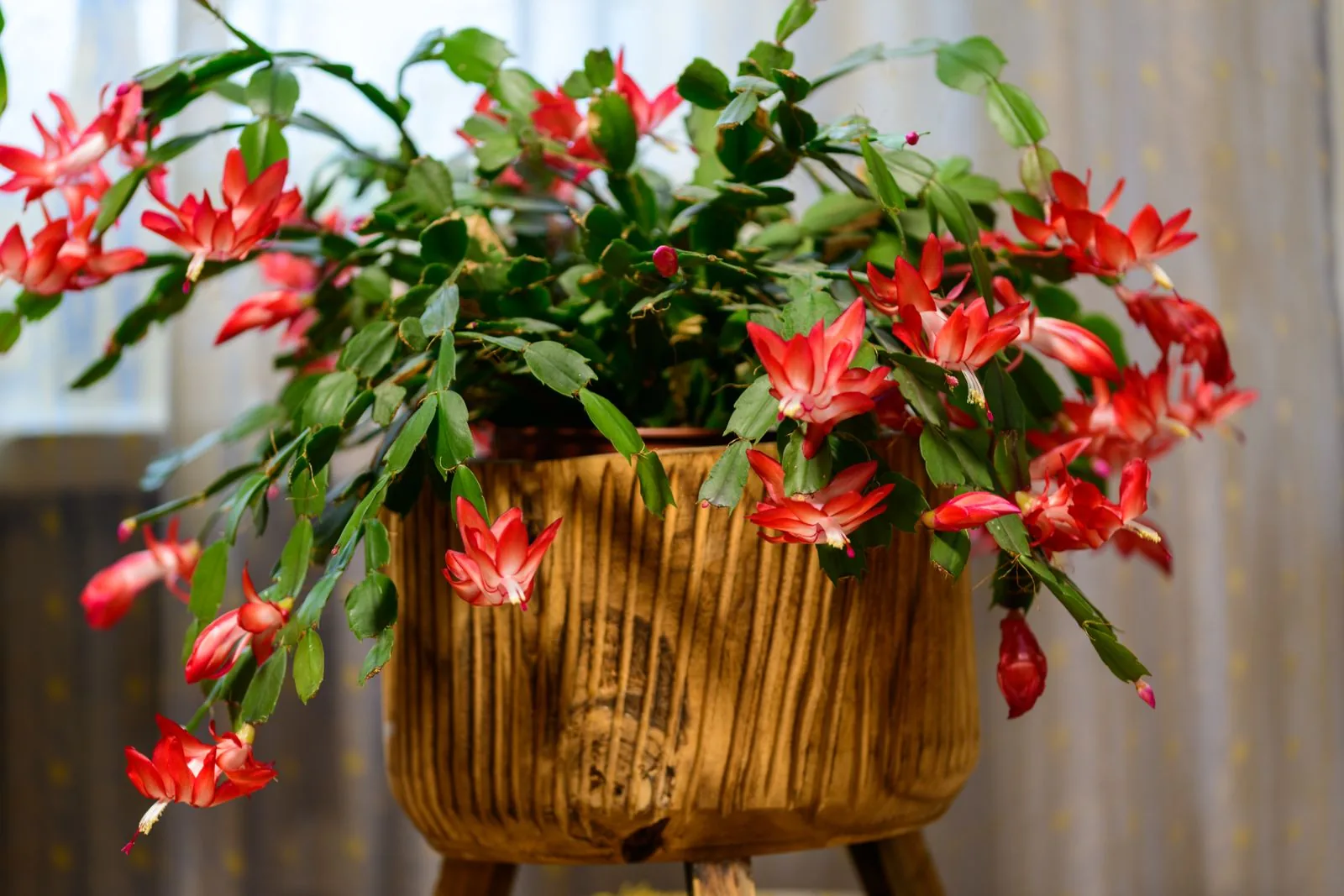
The best fertilizer for Christmas cactus for most people is Jack’s Classic 20-20-20 mixed at half strength once a month from spring through August. It’s the exact type of feed Clemson and Georgia extension recommend (a soluble 20-20-20 with trace elements). Because it contains no magnesium, pair it with a monthly dose of Epsom salt in the off weeks. Stop both in late summer so the plant puts its energy into buds.
If you’d rather measure drops than powder, the TPS Christmas Cactus Fertilizer and Schultz African Violet Plus are the easiest liquid options. The rest of this page covers which bottle suits which grower, and the feeding calendar that decides whether you get flowers at all.
We may earn a commission when you buy through links on this page, at no extra cost to you. As an Amazon Associate we earn from qualifying purchases.
How we chose
We didn’t grow plants side by side. We started from what university extension services say a holiday cactus (Schlumbergera) needs: a balanced soluble feed at half strength during active growth, extra magnesium, and less or no nitrogen in fall. Then we checked each product’s guaranteed analysis (the N-P-K and micronutrient numbers printed on the label) against the manufacturer page or the Amazon listing, and read Amazon’s review summaries for recurring complaints. Ratings below are what Amazon showed on November 21, 2026.
Christmas cactus fertilizers compared
| Product | N-P-K | Magnesium listed? | Form | Label rate | Amazon rating (Nov 2026) |
|---|---|---|---|---|---|
| Jack’s Classic 20-20-20 All Purpose (8 oz) | 20-20-20 | No (B, Cu, Fe, Mn, Mo, Zn only) | Water-soluble powder | 1/2 tsp per gallon (125 ppm N) | 4.8/5, 10,500+ ratings |
| TPS Christmas Cactus Fertilizer (8 oz) | 2-2-3 | Yes (see note) | Liquid with kelp | 1 tsp per quart | 4.7/5, 1,300+ ratings |
| Schultz African Violet Plus (4 oz) | 8-14-9 | Not stated on listing | Liquid drops | 7 drops per quart | 4.7/5, 513 ratings |
| Schultz Cactus Plus (4 oz, 2-pack) | 2-7-7 | Not stated on listing | Liquid drops | 7 drops with every watering | Rating not shown |
| Espoma Organic Cactus! (8 oz) | 1-2-2 | No | Organic liquid with microbes | 1/2 cap (2 tsp) per quart, every 2-4 weeks | 4.6/5, 1,000+ ratings |
| Cz Garden Magnesium Sulfate (5 lb) | 10% Mg, 13% S | Yes, it’s the whole point | Soluble crystals | Extension rate: 1 tsp per gallon, monthly | Rating not shown |
Why Christmas cactus needs a different plan than a desert cactus
Christmas cactus comes from Brazilian rain forest, where it grows on tree branches in humid, dappled light (South Dakota State University Extension). It wants regular, dilute feeding in spring and summer, not the lean diet of a barrel cactus. Clemson’s Home & Garden Information Center adds two specifics most product pages skip. Holiday cacti have a higher magnesium requirement than many plants, and fertilizing should stop in late summer for better fall bud production.
Fertilizer doesn’t make it bloom. Buds form when the plant gets long nights (Clemson says 14 hours or more of continuous darkness, starting around mid-September, for at least 6 weeks) or cool nights. Chicago Botanic Garden puts the cool-night trigger at 50-55°F. A well-fed plant on a lamp-lit end table can still skip flowering, so pick the fertilizer for growth and handle the bloom with light and temperature.
The feeding calendar extension services agree on
- Late winter / early spring, when new segments appear: start feeding. Clemson and UGA say monthly at half strength with a 20-10-20 or 20-20-20 that includes trace elements. SDSU Extension goes further, with a balanced 20-20-20 every two weeks from spring to early fall.
- Spring through summer: keep the monthly feed. In the alternate weeks, give Epsom salt at 1 teaspoon per gallon of water, never in the same week as the fertilizer (Clemson, UGA).
- Late summer (around August): stop, or switch to a low-nitrogen, higher phosphorus and potassium feed. University of Minnesota Extension gives 0-15-10 as an example.
- Fall bud set and winter bloom: no fertilizer needed. Keep the soil evenly moist once buds form, since drying out is one of the causes of bud drop Clemson lists.
Sources disagree on frequency: monthly (Clemson, UGA, UMN) versus every two weeks (SDSU). If your plant sits in a bright window and pushes lots of new segments, the two-week schedule is reasonable. For a plant in average indoor light, monthly at half strength is the safer default.
1. Jack’s Classic 20-20-20 All Purpose: best overall
Who it’s for: growers who want to follow the extension recipe exactly and also feed other houseplants. Skip it if: you only own one small plant and don’t want to measure powder.
Jack’s Classic is the 20-20-20 with trace elements that Clemson and UGA describe. The guaranteed analysis lists boron, copper, iron, manganese, molybdenum and zinc, with the copper, iron, manganese and zinc in chelated form. It lists no magnesium, which is why it pairs well with Epsom salt. The maker’s small-batch chart puts 1/2 teaspoon per gallon at 125 ppm nitrogen, which is a gentle houseplant rate. Most of the nitrogen (17.9 of the 20%) is urea, so it’s a fast-acting feed. Measure it rather than eyeballing it.
Pros
- Matches the formula type extension services recommend for holiday cacti
- Powder makes many gallons. An 8 oz tub with a measuring spoon goes a long way for a few pots
- Amazon’s review summary says buyers see quick results on houseplants and blooming plants, and value it for the cost
- Also works as a foliar spray, per the listing
Cons
- No magnesium, so you still need Epsom salt for the full extension routine
- Easy to overdose. Many Jack’s directions use 1 tablespoon per gallon for outdoor plants, six times the indoor rate
- Powder needs a separate container and stirring
2. TPS Christmas Cactus Fertilizer: best one-bottle option
Who it’s for: anyone who wants a single liquid with magnesium already in it. Skip it if: you want a feed with a long independent track record. This is a niche brand-specific formula.
TPS’s product page lists a 2-2-3 formula with sea kelp (Ascophyllum nodosum), calcium, magnesium, iron, boron, copper, manganese and zinc. The magnesium figure varies by source. The current product page says 1% calcium and 0.5% magnesium, while a label posted on manuals.plus shows 0.5% calcium and 0.25% magnesium. Check the label on the bottle you receive. Either way, it covers the magnesium need without a second product. TPS’s own care guide also says outright that fertilizer doesn’t trigger blooming, which matches the extension advice.
Pros
- Magnesium and calcium included, so there’s no Epsom salt step
- Simple dose of 1 teaspoon per quart
- Low-concentration liquid, which leaves more margin for error than a strong powder mixed by eye
Cons
- The label schedule feeds every 1-2 weeks in spring and summer and every 4 weeks in fall and winter. That’s more fall feeding than Clemson recommends, so we’d stop by late summer anyway
- Published magnesium and calcium percentages differ between sources
- Costs more per feeding than a powder
3. Schultz African Violet Plus 8-14-9: best for growers who already keep violets
Who it’s for: people with several flowering houseplants who want one dropper bottle for all of them. Southern Living notes some gardeners use African violet food on Christmas cactus. Skip it if: you want a 20-20-20-style balance. This one leans toward phosphorus.
The 8-14-9 analysis gives more phosphorus than nitrogen, and the listing says it contains basic micronutrients. Dosing is 7 drops per quart of water. A dropper bottle like this is the least fussy way to make a half-strength mix for one or two pots. The listing doesn’t state magnesium, so we’d still add Epsom salt monthly.
Pros
- Drop dosing is easy for one quart at a time
- Amazon’s review summary says buyers find it effective and easy to use, with one noting stronger, greener leaves
- Small 4 oz bottle, so you aren’t buying a tub you’ll never finish
Cons
- Magnesium not listed. Pair it with Epsom salt
- The listing gives fewer label details than the bigger brands’ spec sheets
4. Schultz Cactus Plus 2-7-7: best low-nitrogen feed
Who it’s for: growers whose plant is leafy but stingy with flowers, and anyone who wants a low-nitrogen option for the end of the growing season. Skip it if: your plant is pale and small. It needs more nitrogen than this gives.
Several top results for this keyword point to a 2-7-7-type ratio for Schlumbergera. Schultz Cactus Plus is the common bottle with that analysis. Label directions are 7 drops with water every time you water, so it delivers a small, steady amount. It isn’t nitrogen-free like the 0-15-10 UMN mentions, so we wouldn’t run it through fall bud set. Use it in summer if you want less push on segment growth.
Pros
- Lower nitrogen than the all-purpose options, with more phosphorus and potassium
- Feed-with-every-watering dosing suits forgetful growers
- Listing gives a 900-day shelf life, and Amazon’s review summary mentions the dropper makes mixing precise
Cons
- Formulated for desert cacti and succulents, not specifically for holiday cacti
- Amazon didn’t show a star rating for this listing when we checked
- Feeding every watering makes it easy to forget the late-summer stop
5. Espoma Organic Cactus! 1-2-2: best organic option
Who it’s for: growers who want an organic-approved feed. Espoma lists hydrolyzed poultry manure, bone meal, potassium sulfate, soy and fish protein and kelp extract. Skip it if: the plant lives in a living room and smells bother you.
Espoma’s fact sheet guarantees 1% nitrogen, 2% phosphate and 2% potash, plus seven strains of beneficial bacteria and fungi and humic acid. Directions are 1/2 cap (2 teaspoons) per quart, drenched through the pot, every 2-4 weeks. At 1-2-2 it’s mild. Fed monthly at the label rate, it’s already gentle enough that you don’t need to halve it.
Pros
- Organic ingredients with a published guaranteed analysis
- Mild 1-2-2 strength lowers the risk of overfeeding a small pot
- Amazon’s review summary reports strong growth on succulents and an old cactus revived
Cons
- Odor is the most common complaint in Amazon’s review summary (32 mentions)
- Mixed opinions on the measuring cap
- No magnesium listed. Add Epsom salt
6. Cz Garden Magnesium Sulfate: the magnesium add-on
Who it’s for: anyone using Jack’s, Schultz or Espoma, none of which list magnesium. Skip it if: you use the TPS bottle, which already contains magnesium.
This is plain Epsom salt sold for gardens. The listing gives 10% magnesium and 13% sulfur, says it’s greenhouse grade and fully water-soluble, and the title says it’s OMRI Listed. Clemson’s rate is 1 teaspoon per gallon, once a month during the growing season, in a different week from the regular fertilizer. Southern Living adds that it shouldn’t be the only thing you feed. Epsom salt supplies magnesium and sulfur, not nitrogen, phosphorus or potassium.
Pros
- Covers the magnesium requirement extension services single out for holiday cacti
- A teaspoon per gallon means a 5 lb bag lasts for years on a few houseplants
- Also usable in the vegetable garden
Cons
- 5 lb is far more than one plant needs. Any plain unscented Epsom salt does the same job
- Amazon didn’t show a star rating for this listing when we checked
- It’s a second product and a second schedule to remember
Which one fits your situation
- You have several houseplants and want the extension recipe: Jack’s 20-20-20 at 1/2 tsp per gallon monthly, plus Epsom salt two weeks later. The powder also feeds your other plants, and the indoor plants in our indoor plant fertilizer guide take a similar routine.
- You have one Christmas cactus and want one bottle: TPS Christmas Cactus Fertilizer. Stop feeding in late summer even though the label continues.
- Your plant grows lots of segments but few flowers: first check for light at night. Then try Schultz Cactus Plus in summer instead of a 20-20-20.
- You want organic: Espoma Cactus!, plus Epsom salt, kept in a room where the smell won’t bother anyone.
Watering affects how well any of these work. Fertilizer goes on moist soil, and Clemson names root rot from overwatering as the main disease. A soil moisture meter takes the guessing out of when the pot is ready. Fungus gnats in wet potting mix are on Clemson’s pest list too. Our fungus gnat traps page covers those.
FAQ
What NPK is best for Christmas cactus?
During growth, extension services recommend a balanced 20-20-20 or 20-10-20 with trace elements at half strength. In fall they suggest stopping, or switching to a low-nitrogen formula such as 0-15-10 (UMN). Lower-nitrogen ratios like 2-7-7 are a reasonable summer choice for leafy plants that flower poorly.
Is Epsom salt good for Christmas cactus?
Yes, as a supplement. Clemson and UGA both say holiday cacti need more magnesium than many plants and recommend 1 teaspoon of Epsom salt per gallon monthly during the growing season, not in the same week as the fertilizer. It doesn’t replace a complete fertilizer.
Should I fertilize a Christmas cactus while it’s blooming?
No. Clemson advises stopping in late summer so the plant sets more buds, and Chicago Botanic Garden says not to fertilize while you’re giving it the dark period for reblooming. Resume when new growth starts in late winter or spring.
Can I use African violet food on a Christmas cactus?
Yes. Southern Living notes some gardeners prefer it, and an 8-14-9 like Schultz African Violet Plus is in the low-nitrogen, bloom-leaning range. Add Epsom salt monthly, since the listing doesn’t state magnesium.
Why does my Christmas cactus drop its buds?
Clemson lists too many buds, sudden changes in temperature or light, and the potting mix drying out. Bud drop can also happen at 50°F. Fertilizer isn’t the fix. Keep the soil evenly moist and leave the pot in one place once buds form.
Sources
Checked November 21, 2026.
- Clemson HGIC, Thanksgiving & Christmas Cacti: hgic.clemson.edu/factsheet/thanksgiving-christmas-cacti/ (fertilizer type and timing, magnesium/Epsom rate, long nights, bud drop, pests)
- UGA CAES, Control light and Christmas cactus will bloom: fieldreport.caes.uga.edu (half-strength 20-20-20, Epsom salt)
- University of Minnesota Extension, Holiday cacti: extension.umn.edu (June-August feeding, 0-15-10 in fall)
- SDSU Extension, A Cactus for Every Holiday: extension.sdstate.edu (native habitat, 20-20-20 every two weeks)
- Chicago Botanic Garden, Christmas Cactus: chicagobotanic.org (50-55°F cool-night trigger, no feeding during dark treatment)
- Southern Living, How and when to fertilize your Christmas cactus: southernliving.com (African violet food, Epsom salt is not the only feed)
- Jack’s Classic 20-20-20 guaranteed analysis and ppm chart: greenhousemegastore.com; J.R. Peters technical bulletin: jrpeters.com (outdoor rate)
- TPS Christmas Cactus Fertilizer product page: store.tpsplantfoods.com (2-2-3, minerals, schedule); TPS care guide: tpsplantfoods.com; older label on manuals.plus (0.5% Ca, 0.25% Mg)
- Espoma Cactus! fact sheet: domyown.com (PDF); product page: espoma.com
- Amazon listings via Creators API and amazon.com review summaries, Nov 21, 2026: ASIN B005LKNCZY (Jack’s), B0CPGGCRT8 (TPS), B01EVU05AY (Schultz African Violet Plus), B01E82THI6 (Schultz Cactus Plus), B01JIRKYJ2 (Espoma), B0CXKXB9F7 (Cz Garden Magnesium Sulfate): features, dosing, ratings